Queer Places:
Yale University (Ivy League), 38 Hillhouse Ave, New Haven, CT 06520
Cedar Grove Cemetery, 638 Broad St, New London, CT 06320, United States
 George Shepard Palmer (March 20, 1855 - January 23, 1934) was born on March 20, 1855, in Montville, New London County, Connecticut, to the Honorable Elisha Hulbert Palmer
and Ellis Loomis Palmer. Raised alongside his siblings—Elisha, Edward, Frederic, Mary, Arabella, and Frank—he went on to attend the Norwich Free Academy before graduating
from Yale University.
George Shepard Palmer (March 20, 1855 - January 23, 1934) was born on March 20, 1855, in Montville, New London County, Connecticut, to the Honorable Elisha Hulbert Palmer
and Ellis Loomis Palmer. Raised alongside his siblings—Elisha, Edward, Frederic, Mary, Arabella, and Frank—he went on to attend the Norwich Free Academy before graduating
from Yale University.
As a business leader, Palmer established the Palmer Brothers company, which eventually grew to become the largest manufacturer of its goods in the country. Beyond his
commercial success, he was deeply committed to civic and educational life, maintaining a long-standing association with Connecticut College that included serving as the
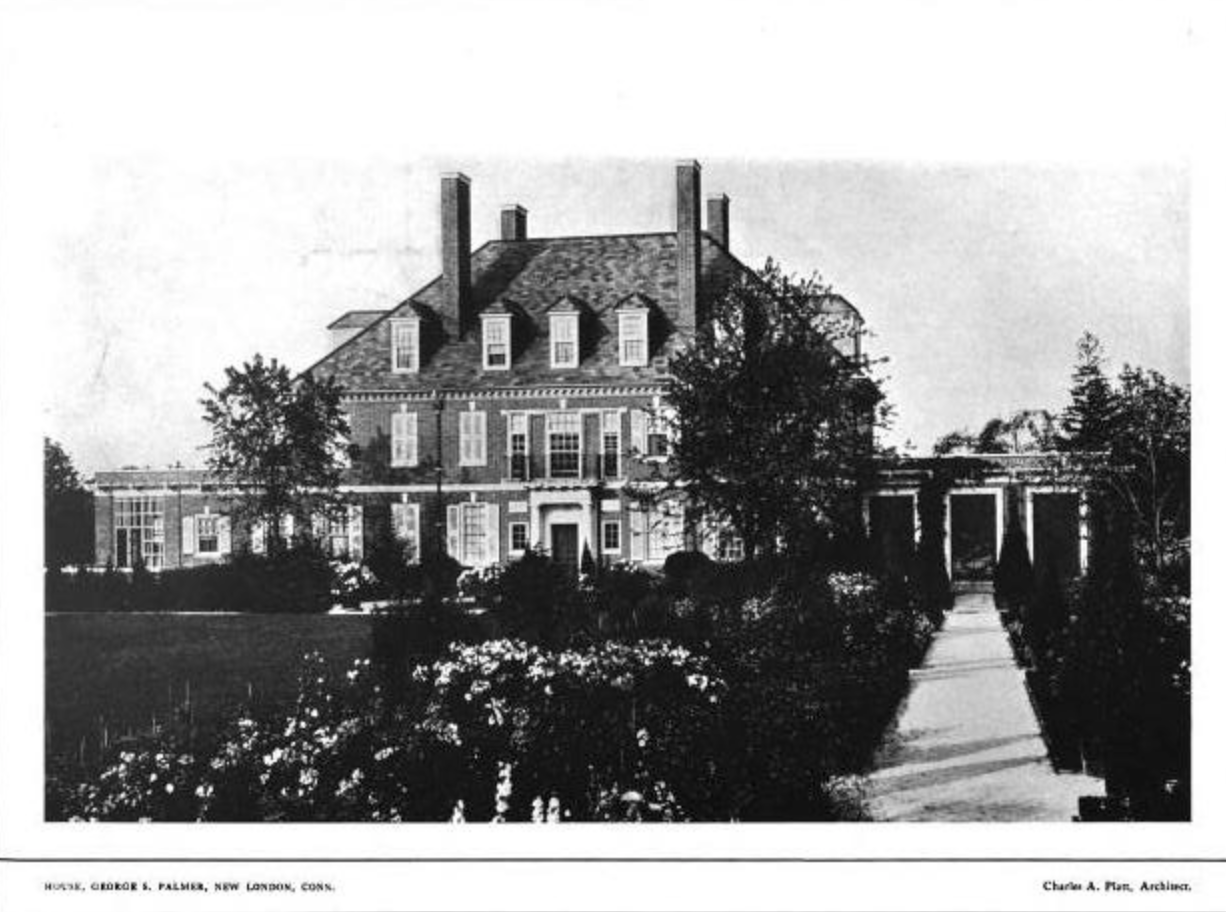
chairman of the board of trustees. He also established a prominent New London footprint by building "Westomere," a grand estate on Pequot Avenue situated on the former
property of Henry Goelet McVickar.
"Westomere" was a magnificent Gilded Age country estate built around 1908. Situated on Pequot Avenue, within the fashionable shoreline enclave known as the Pequot Colony,
the mansion was designed by the renowned prominent architect Charles A. Platt, who was celebrated for his mastery of Italian
Renaissance-inspired architecture, formal gardens, and harmonious integration of buildings with their natural landscapes.
The architectural concept for Westomere was directly modeled after Westover Plantation, the famous 18th-century Georgian brick mansion located in Charles City County,
Virginia. Platt adapted these classic colonial and Georgian Revival motifs to create a stately, symmetrical structure perfectly suited for the New England coast. True to its
premier location along Pequot Avenue, the estate featured sweeping, expansive lawns with deep setbacks that offered commanding, panoramic views overlooking the Thames River
as it opened into Long Island Sound. Westomere was widely considered a masterpiece of early 20th-century American domestic architecture. Its acclaim was cemented when it was
ranked No. 9 on Country Life in America magazine's prestigious 1916 list of the "Best Twelve Country Houses in America." Beyond its structural elegance, the home served as
an exquisite backdrop for Palmer's peerless collection of early American decorative arts and furniture. Exceptional pieces from his collection—such as the famous
Palmer-Franklin Chippendale mahogany bonnet-top high chest—were famously housed as functional showpieces within Westomere's carefully appointed rooms before eventually
finding their way into major museum collections like the Metropolitan Museum of Art. Like many of the grand coastal estates of its era, Westomere is no longer extant, but it
remains an architectural landmark of the Gilded Age in Connecticut.
Palmer's personal life included two marriages. He wed his first wife, Ida Amelia Cooke, in 1879 until her passing in 1896, and later married Neva L. Fenno in 1901.
Throughout his life, he became a dedicated and early enthusiast of American decorative arts, assembling a significant collection of Americana. His standing in the
antiquarian community was recognized in 1910 when he was elected to the Horace Walpole Society, an exclusive,
invitation-only organization of prominent collectors, scholars, and patrons where he remained a member for the rest of his life.
Palmer passed away on January 23, 1934, at the age of 78 at Mountain Lake Station in Polk County, Florida. Extensive coverage of his life and legacy was published in The
New London Day, and his body was brought back to Connecticut for burial at Cedar Grove Cemetery in New London. At the time of his death, he was survived by his wife Neva, as
well as his children Howard, Neva, and Priscilla.
While historical documentation of personal private orientations from the Gilded Age and early 20th century is frequently unrecorded or intentionally obscured, elite early
collectors of American decorative arts—such as the tight-knit core of the Horace Walpole Society—frequently operated within homosocial spaces. Exclusive men's clubs, elite
institutions like Yale University, and all-male antiquarian societies served as primary social frameworks for wealthy industrialists of the era. Scholars of queer history
note that many prominent tastemakers of Palmer’s social strata built homosocial domestic environments, such as expansive private estates like Westomere, which supported
non-traditional households, close-knit male mentorships, and homosocial patronage networks that ultimately laid the groundwork for modern American museum culture.
References:
- Genealogical & Biographical Data: Compiled from archival birth, marriage, death, and census records, alongside data hosted via Find a Grave (Cedar Grove Cemetery and Avery Cemetery records).
- Obituary Reference: The New London Day, Wednesday, January 24, 1934, Page 6, Columns 6, 7, and 8.
- Society Membership & Cultural Context: Research archives and membership rolls of the Horace Walpole Society (with records housed permanently in the Joseph Downs Collection of Manuscripts and Printed Ephemera at the Winterthur Museum) and documentation via queer history and biographical compendiums tracking early American decorative arts collectors and homosocial networks.
Support this project
This website is a passion project researched, developed, and funded entirely by me. If you find the content valuable and would like to help support the ongoing research and hosting costs, any contribution is deeply appreciated.
Thank you for keeping this independent resource alive!
My books on Amazon: Elisa Rolle's books
BACK TO HOME PAGE